
R-410A Technical Guide
R-410A Technical Guide - HVAC Contractor Reference
This comprehensive R410A Technical Guide provides accurate field data, pressure-temperature charts, and best practices for HVAC contractors, service technicians, and trade buyers. R-410A remains the dominant refrigerant in installed air conditioning and heat pump systems across the United States, and will continue as a major service refrigerant for years even as new equipment transitions to lower-GWP alternatives.
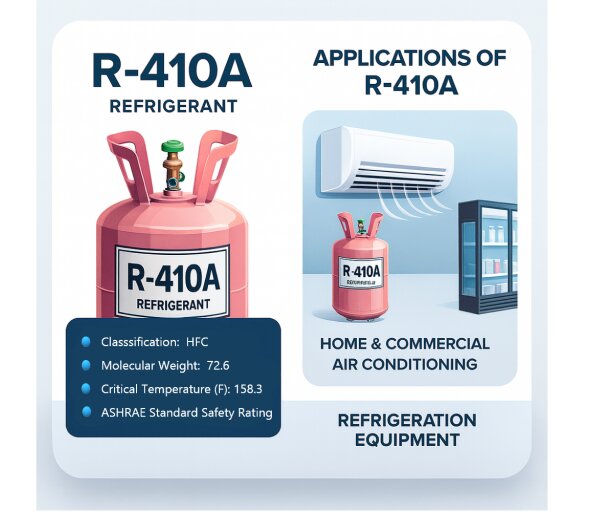
What Is R-410A?
R-410A is a near-azeotropic HFC blend developed as a non-ozone-depleting replacement for R-22 in residential and light commercial comfort cooling systems. The refrigerant consists of a 50/50 mixture of R-32 and R-125, offering minimal temperature glide and excellent thermodynamic properties.
Unlike R-22, R-410A operates at significantly higher pressures—approximately 50-60% higher under similar conditions. This requires dedicated equipment, tools, and components specifically rated for R-410A service pressures. Systems designed for R-22 cannot be directly converted to R-410A due to these pressure differences and incompatible lubricants.
Important: R-410A systems require POE (Polyolester) oil only. Never use mineral oil or alkylbenzene oils designed for R-22 systems.
R-410A Technical Specifications
| Property | Value | Notes |
|---|---|---|
| Blend Composition | 50% R-32 / 50% R-125 | Near-azeotropic blend with minimal glide |
| ASHRAE Safety Class | A1 | Non-flammable, low toxicity |
| Ozone Depletion Potential | 0 | No chlorine content |
| Global Warming Potential | ~2088 (100-year) | High GWP - subject to phasedown |
| Boiling Point (1 atm) | -48.5°C (-55.3°F) | Similar operating range to R-22 |
| Critical Temperature | 72.8°C (163°F) | Enables efficient cooling cycles |
| Oil Compatibility | POE Only | Polyolester lubricants required |
| Operating Pressures | 50-60% higher than R-22 | Requires rated components and tools |
Common Applications
- Residential split systems: Central air conditioning and heat pump systems
- Package units: Rooftop and ground-level packaged HVAC equipment
- Ductless mini-splits: Single and multi-zone heat pump systems
- Light commercial: Small commercial buildings and retail spaces
- Variable refrigerant flow (VRF): Multi-zone commercial systems
R-410A Pressure-Temperature Chart
The pressure-temperature relationship is critical for proper system charging, diagnostics, and troubleshooting. Use this chart to match measured gauge pressures to saturation temperatures during service work. Always combine PT readings with superheat and subcooling measurements for accurate charging.
Professional R-410A PT Chart - Values shown are saturation pressures at specified temperatures. Use in conjunction with manufacturer specifications and field measurements.
Quick Reference Pressures (Approximate)
| Temperature (°F) | Pressure (psig) | Typical Application |
|---|---|---|
| 40°F | 118 psig | Low evaporator temp |
| 50°F | 134 psig | Cool weather operation |
| 60°F | 152 psig | Moderate conditions |
| 70°F | 172 psig | Standard comfort cooling |
| 80°F | 195 psig | Warm ambient conditions |
| 90°F | 221 psig | High outdoor temps |
| 100°F | 249 psig | Peak summer conditions |
| 110°F | 280 psig | Extreme heat operation |
Charging & Service Best Practices
Critical Charging Guidelines
- Always charge as liquid: R-410A is a blended refrigerant. Charging as vapor can cause fractionation, altering the blend ratio and system performance. Invert the cylinder or use a liquid charging valve.
- Use R-410A rated equipment: Gauges, hoses, recovery machines, and cylinders must be rated for higher R-410A pressures (typically 800+ psig rating).
- Verify airflow first: Improper airflow across evaporator or condenser coils mimics refrigerant charge issues. Check filters, coils, and blower operation before adding refrigerant.
- Charge by superheat or subcooling: Follow OEM specifications for target superheat (fixed orifice systems) or subcooling (TXV systems). Pressure readings alone are insufficient.
- Weigh in refrigerant when possible: Electronic scales provide the most accurate charging method, especially for critical charge systems.
Technician Tip: R-410A systems are often "critical charge" systems where even small variations (±2-4 oz) significantly impact performance. Always use precise charging methods and verify with superheat/subcooling measurements.
Required Tools & Equipment
- R-410A gauge set (800+ psig rated)
- Electronic refrigerant scale
- Digital manifold with superheat/subcooling calculation
- Recovery machine rated for R-410A
- Vacuum pump (minimum 500 microns)
- Leak detection equipment
- Temperature probes for line measurements
System Evacuation Requirements
Proper evacuation is critical for R-410A systems due to POE oil's hygroscopic nature (readily absorbs moisture). Evacuate systems to 500 microns or below and hold for at least 10 minutes to ensure all moisture is removed. Deep vacuum prevents acid formation and system contamination.
Safety & Handling
ASHRAE A1 Classification
R-410A is classified as ASHRAE A1: non-flammable with low toxicity. While generally safe to handle, proper safety protocols must always be followed during service work.
Storage & Transport
- Store cylinders upright in well-ventilated areas
- Secure cylinders during transport to prevent rolling or tipping
- Keep away from heat sources and direct sunlight
- Never expose cylinders to temperatures above 125°F
- Do not overfill—cylinders should not exceed 80% liquid capacity
EPA Section 608 Compliance
R-410A is regulated under EPA Section 608 of the Clean Air Act. Technicians must be EPA certified to purchase and handle R-410A. All service work must follow proper recovery procedures, leak repair requirements, and recordkeeping obligations.
EPA Certification Required: Type I (small appliances), Type II (high-pressure), or Universal certification is required to purchase and service R-410A systems.
R-410A Phaseout & Replacement Timeline
Under the EPA's American Innovation and Manufacturing (AIM) Act, the United States is implementing a gradual phasedown of high-GWP HFCs, including R-410A. The phasedown reduces HFC production and import allowances through 2036, with major reductions occurring in 2025-2026.
Key Timeline Points
- 2025: Many manufacturers transitioning new residential AC and heat pump equipment to R-32 or R-454B
- 2026: Additional GWP restrictions on new equipment sectors
- 2028-2036: Continued phasedown of HFC production allowances
What This Means for Contractors
- Existing systems: R-410A remains legal for servicing existing equipment indefinitely
- New equipment: Manufacturers are transitioning to lower-GWP alternatives (primarily R-32 and R-454B)
- Supply availability: R-410A supply will gradually tighten over time as production allowances decrease
- No retrofits required: Property owners are not required to replace functioning R-410A systems
Planning Ahead: While R-410A will remain available for service work, consider stocking adequate inventory and familiarizing yourself with replacement refrigerants like R-32 and R-454B for new installations.
R410A Technical Guide - Frequently Asked Questions
Is R-410A still legal to buy and use in 2025?
Yes, R-410A remains completely legal to purchase and use for servicing existing HVAC systems. The EPA phasedown targets production allowances, not service work. Contractors can continue using R-410A for repairs and maintenance on installed systems.
What refrigerants are replacing R-410A in new equipment?
The two primary replacements are R-32 (single-component HFC with GWP of 675) and R-454B (HFC/HFO blend with GWP of 466). R-32 offers simpler composition and higher efficiency, while R-454B provides closer performance match to R-410A. Manufacturers are adopting different strategies based on their equipment platforms.
Can I retrofit an R-22 system to use R-410A?
No, R-22 systems cannot be safely converted to R-410A. The pressure differences (R-410A runs 50-60% higher pressures) mean components, compressors, and pressure vessels are not rated for R-410A service. Additionally, R-410A requires POE oil while R-22 uses mineral oil. Use approved R-22 replacement refrigerants designed for retrofit applications instead.
Why must R-410A be charged as liquid instead of vapor?
R-410A is a blended refrigerant containing R-32 and R-125 in specific proportions. When charged as vapor, the lighter component (R-32) evaporates first, changing the blend ratio in the cylinder and the system. This fractionation degrades performance. Always charge R-410A as liquid to maintain proper blend composition.
What oil must be used with R-410A systems?
R-410A systems require Polyolester (POE) oil exclusively. POE oil is compatible with the HFC chemistry of R-410A and provides proper lubrication at system operating pressures. Never use mineral oil, alkylbenzene, or other oils designed for older refrigerants. Using incorrect oil causes compressor failure and system damage.
How does R-410A pricing compare to other refrigerants?
R-410A pricing varies based on market conditions, supply constraints, and purchase volume. As the EPA phasedown progresses, prices may increase due to reduced production allowances. Contractors can secure better pricing through volume purchases, pallet orders, and wholesale accounts. Contact us for current R-410A pricing and volume discounts.
What EPA certification do I need to work with R-410A?
EPA Section 608 certification is required to purchase and service R-410A systems. Type II (high-pressure systems) or Universal certification covers residential and commercial air conditioning work. Type I (small appliances) does not cover typical R-410A applications. Certification involves passing an EPA-approved exam covering refrigerant handling, recovery, and environmental regulations.
Order R-410A Refrigerant
AAA Refrigerant supplies EPA-certified R-410A in 25lb cylinders with options for single units, quarter pallets, half pallets, and full pallet orders. We offer competitive wholesale pricing, volume discounts, and fast shipping to HVAC contractors nationwide.