
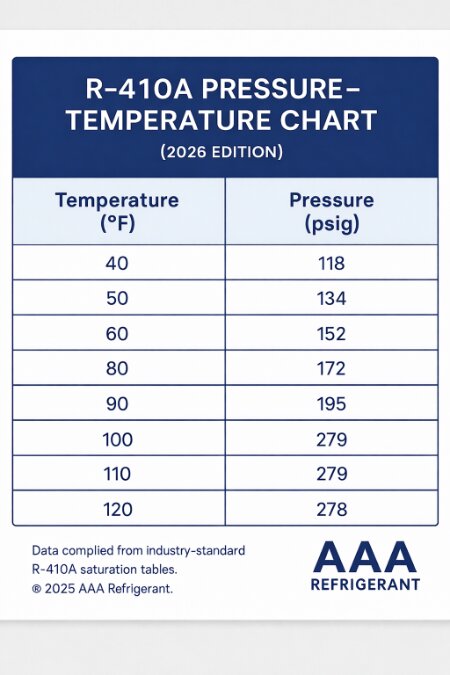
Values are approximate saturation pressures for field reference. Always confirm with calibrated gauges and follow OEM procedures.
Quick Links
Common Questions
What should suction pressure be at 45°F saturation?
What is a normal R-410A operating pressure range?
Why is my suction pressure low?
Why is my high-side pressure too high?
Can I still buy R-410A in 2025–2026?
What oil does R-410A require?
R-410A Pressure–Temperature (PT) Reference Chart
The table below provides approximate R-410A saturation pressures across the operating temperature range most HVAC technicians encounter in the field. Use it alongside your manifold gauges to estimate evaporator and condenser saturation temperatures, then calculate superheat and subcooling against OEM targets to guide charge and diagnostic decisions.
R-410A Saturation Pressure–Temperature Table
| Temperature (°F) | Saturation Pressure (psig) | Typical Application |
|---|---|---|
| 0°F | 29 psig | Low-temp / winter ambient |
| 10°F | 40 psig | — |
| 20°F | 52 psig | — |
| 30°F | 67 psig | — |
| 40°F | 83 psig | Low-side diagnostic ref. |
| 45°F | 130 psig | Typical suction sat. temp. |
| 50°F | 117 psig | — |
| 60°F | 151 psig | — |
| 70°F | 188 psig | — |
| 80°F | 230 psig | — |
| 90°F | 276 psig | Typical liquid line / cond. ref. |
| 100°F | 327 psig | High-side diagnostic ref. |
| 110°F | 383 psig | — |
| 120°F | 445 psig | High ambient / elevated head |
| 130°F | 513 psig | High-ambient limit |
Values are rounded for field convenience. Compile from industry-standard R-410A saturation data. Charge decisions must be based on full system diagnostics including superheat, subcooling, airflow, and OEM documentation.
What Is R-410A?
R-410A is a near-azeotropic HFC blend (50% R-32 / 50% R-125) used in the majority of residential and light-commercial comfort-cooling systems installed from the mid-1990s through 2024. It replaced R-22 as the dominant comfort-cooling refrigerant and operates at significantly higher pressures — approximately 40–70% higher than R-22 — making R-22 PT charts and manifold sets incompatible with R-410A equipment.
Under the AIM Act, new HVAC equipment using R-410A was phased out beginning January 1, 2025. However, R-410A remains legal for purchase and use in servicing the enormous existing installed base, which will require service refrigerant for many years to come.
How to Use This PT Chart for Field Diagnostics
Step 1 — Record Actual Gauge Pressures
Connect your manifold gauge set to the low-side (suction) and high-side (discharge/liquid) service ports. Record steady-state pressures after the system has been running for at least 10–15 minutes.
Step 2 — Look Up Saturation Temperatures
Find the measured suction pressure in the PT table and read the corresponding saturation temperature — this is your evaporator saturation temperature. Repeat for the liquid line pressure to find your condenser saturation temperature.
Step 3 — Calculate Superheat and Subcooling
- Superheat = Suction line temperature (measured at service valve) − Evaporator saturation temperature. Compare to OEM target (typically 10–20°F for fixed-orifice systems).
- Subcooling = Condenser saturation temperature − Liquid line temperature (measured at liquid line). Compare to OEM target (typically 10–15°F).
Gauge pressure readings must always be interpreted alongside temperature measurements, superheat, subcooling, airflow data, and OEM specifications. A pressure that looks "off" on the PT chart may be normal for a given system's operating conditions.
Common Diagnostic Scenarios
- Low suction pressure + high superheat: Likely undercharge or restriction at metering device.
- Low suction pressure + low superheat: May indicate low evaporator load or low airflow — not necessarily undercharge.
- High head pressure + high subcooling: Probable overcharge or non-condensables; check condenser airflow.
- High head pressure + low subcooling: Likely condenser airflow problem or high ambient temperature.
- Normal pressures + high superheat: Check for airflow restrictions or a failing TXV.
R-410A System Specifications at a Glance
- Refrigerant type: HFC blend (R-32/R-125, 50/50 by weight)
- Oil type: Polyolester (POE) — required; do not mix with mineral oil
- GWP: 2,088
- Normal boiling point: −61.9°F (−52.2°C)
- Critical pressure: ~723 psig
- Container color code: Rose/pink (per ARI 700 convention)
- EPA Section 608 certification required to purchase in containers over 2 lbs
R-410A Phase-Out: What Technicians Need to Know
The AIM Act eliminated new R-410A equipment production effective January 1, 2025. Manufacturers have transitioned to lower-GWP alternatives including R-454B (the most common drop-in successor), R-32, and R-466A. While these refrigerants are used in new equipment, existing R-410A systems will require service refrigerant for the duration of their operating life — typically 15–25 years. Supply of R-410A service refrigerant continues, though market pricing has experienced volatility as the industry transitions.
If you're planning for the long term, understanding the R-454B and R-32 PT charts now will prepare your technicians for the systems already being installed today.